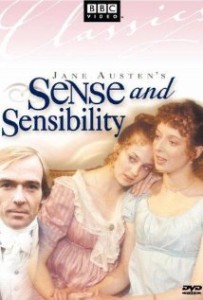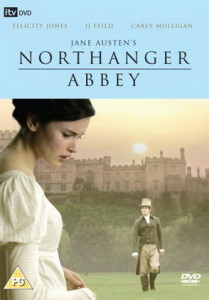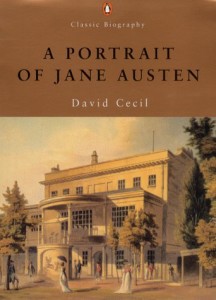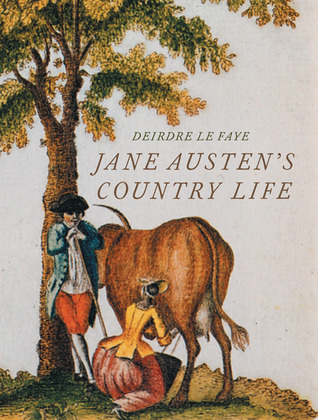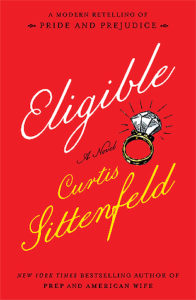
I bought this book based on the review in the Jane Austen Regency World magazine – they were very favourable. Just by looking at the cover I should have known better.
The Importance of Being Emma – Juliet Archer
Nov 30th, 2009 by admin
The Absentee – Maria Edgeworth
Nov 23rd, 2009 by admin
I was pleasantly surprised by this novel – it’s very readable (unlike some of Fanny Burney’s work).
Here’s what’s on the back …
Maria Edgeworth’s sparkling satire about the Anglo-Irish family of an absentee landlord is also a landmark novel of morality and social realism.
The Absenteecentres around Lord and Lady Clonbrony, a couple more concerned with London society than their duties and responsibilities to those who live and work on their Irish estates. Recognising this negligence, their son Lord Colambre goes incognito to Ireland to observe the situation and trace the origins of his beloved cousin Grace. To put matters straight he finds a solution that will bring prosperity and contentment to every level of society, including his own family.
Although the time period and the phraseology is very similar to Austen, this novel lacks the sparkling wit and is very didactic – I occasionally felt I was being beaten over the head with the message.
But it is worth reading for the social history. Also I think it’s a good thing to read things Austen read and to realise how extraordinarliy talented she was (i.e in comparison with the predecessors).
The Absentee – Maria Edgeworth
Nov 16th, 2009 by admin
 I’ve had this book in my ‘to be read’ pile for quite some time. I thought the Everything Austen Challenge would be a good opportunity to force me to read it.
At the moment I’m about a third of the way through and I have to admit that I like it. Edgeworth has none of Austen’s wit, but her phraseology is eerily similar. I will write a proper review later.
Northanger Abbey the Play!
Oct 28th, 2009 by admin
I saw a theatrical adaptation of Northanger Abbey. It was adapted for the stage by Tim Luscombe and directed by Theo Messenger.
I thought the adaptation was fabulous – bits of The Mysteries of Udolpho was mixed in and it seemed to cover all of the major plot points.
The play I saw an amateur production (this one) and it was obvious that the actors were nervous (I thought they were all great) – it took them a while to warm up and you could hear a bit of backstage noise and the costumes were dreadful – ill fitting, wrong style at times and crinkled. I know they don’t have a lot of money, but surely they could have altered the items to fit and what about using an iron? Having said all of that, it was a great evening’s entertainment.
Lady Susan as an E Book
Oct 13th, 2009 by admin
My local Jane Austen group are reading the Juvenilia for our next meeting. I’ve always liked Lady Susan and thought it would be good to try an ebook on my Ipod Touch (I have the ereader application).
I found a copy at Girlebooks - I do like the portability of an ereader. My ipod goes everywhere with me (it has my calendar as well as contact details in it), so I always have a book with me. The application is great – you can change things like the font and the colour of the background - however the screen is really too small and I’m not sure I would want to carry around a bigger version (might as well have the book).
Back to Girlebooks – they have a fabulous section of women writers – Austen, Gaskell, Montgomery, Burney etc.
Mansfield Park 1983 BBC
Oct 12th, 2009 by admin
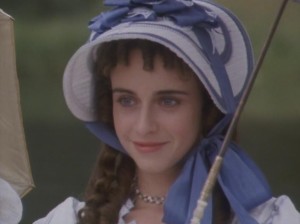
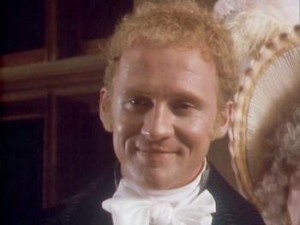
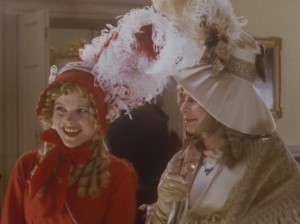
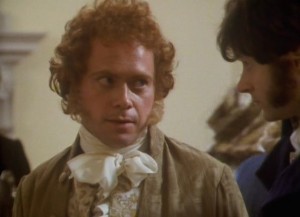
This is a six part adaptation that is very faithful to the novel. It first aired in the UK in 1983. Check out the IMDb site.
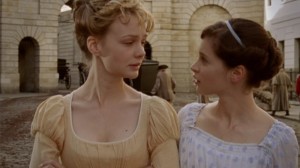
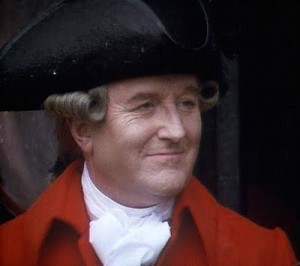
To a modern audience familiar with the beautiful recent Austen adaptations, such as Sense and Sensibility, this seems dated and dull. And very quiet – there is no music in the background. It definitely lacks sparkle and prettiness (we need Andrew Davies involved).
Having said that, the acting is brilliant and as the screenplay follows the novel closely, it’s our only choice if we want to watch a faithful adaptation.
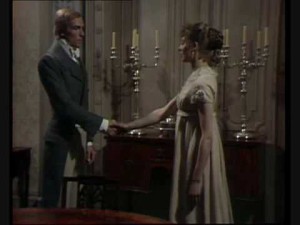
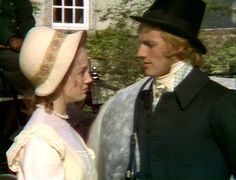
Here are some screen shots …
Opening Screen
Young Fanny and Edmund
Fanny Price
Miss Crawford, Edmund and Fanny
Miss Bertram and Mr Crawford
Fanny and Edmund
The Wedding!
Here are some more reviews…
From the Jane Austen Centre
http://www.janeausten.co.uk/magazine/index.ihtml?pid=104&step=4
From Screen Online
http://www.screenonline.org.uk/tv/id/1182461/index.html
Â
Lost in Austen (Everything Austen Challenge)
Oct 11th, 2009 by admin
I’m giving up on this one. I made it to stage two, but I lack the motivation to continue.
I find the concept intriguing and I think it would be quite fun to do as a group.
If you’re extremely familiar with Pride and Prejudice then I recommend just reading the bits where you have to make decisions – Ms Webster paraphrases Pride and Prejudice, but if you’ve read the original why would you want to read a lesser version?
Next up Mansfield Park (the BBC adaptation).
Everything Austen Challenge – Lost in Austen
Sep 30th, 2009 by admin
Everything Austen Challenge – Mansfield Park
Sep 1st, 2009 by admin
Mansfield Park is my least favourite Austen novel. I’ve always secretly preferred Mary Crawford, didn’t think the theatricals was that bad and hoped that Fanny and Frank Churchill would get married. I thought the Everything Austen Challenge was a great opportunity to read it again.
It contains some fabulous Austen quotes – such as …
But there certainly are not so many men of large fortune in the world as there are pretty women to deserve them.
and
A large income is the best recipe of happiness I ever heard of
and
 Selfishness must always be forgiven, you know, because there is no hope of a cure.
What I really noticed this time was how isolated and powerless Fanny Price was – nobody, apart from Edmund, seems to think about her at all (and Mrs Norris is simply evil).
She has amazing strength of character to hold out when everyone (including Edmund) wants her to marry Frank Churchill – I’m not sure how I would go in similar circumstances.
Mary and Frank Churchill are witty and engaging, but it’s all on the surface. They are both selfish and vain thinking only of themselves. Austen seems to making a point (a bit like Mr Wickham in Pride and Prejudice) that surface appearances can be misleading. The theatricals to a modern mind don’t seem too bad, but it’s more about the intimacy generated by repeated rehearsals – just think of all of those Hollywood actors who fall in love with their co-stars.
And one final thought, did Austen provide Fanny with more strength than she herself had (when accepting and the rejecting Harris Bigg Wither’s proposal)?
I shall think highly of Mansfield Park from now on … Fanny might even be my favourite heroine.
Next up Lost in Austen by Emma Campbell Webster – look I’ve almost caught up now I just need to get Lost in Austen finished by the end of september.
Jane’s Fame – Chapter Six – Jane Austen TM
Aug 17th, 2009 by admin
I finished!
Chapter Six is about the Jane Austen brand.
Austen is both a popular author and a great one. As such she exists in several mutually exclusive spheres – she is all things to all men.
The middle aged, the middle class and those who consider themselves slightly above the middlebrow are Austen’s natural constituency. They (we!) love Austen – the idea as much as the books – because she comes from our own ranks and rocks no boats.
One of the main reasons for Austen’s popularity is the romance plot. In 2004 more than half of all paperbacks sold were romances. Contemporary ‘chick lit’ owes much to Austen – her heroes don’t dominate they can almost seem like ‘sensitive new aged men’. In fact, some critics (mostly men) complain that her heroes are a bit girly and recent screen adaptations have included extra manly scenes; Edward Ferrars chopping wood, Darcy fencing, etc.
Since 1995 there has been many film and television adaptations. Viewers seem happy to see multiple treatments of the same story. Changes in technology has also affected the way we watch the adaptations – we are now ‘super-familiar’ with the material.
There is a section on prequels and sequels and another section on the Internet (blogs, etc).
An appealing attribute of Austen is ‘being for us and for our time’. She is timeless – like all great artists she inhabits a sphere outside time. Harman believes Austen worked to make her novels timeless because it is so hard to update a contemporary novel – think about the delay between the writing of First Impressions and Pride and Prejudice.