Monthly Archives: August 2009

Jane’s Fame – Chapter Six – Jane Austen TM

I finished!

Chapter Six is about the Jane Austen brand.

Austen is both a popular author and a great one. As such she exists in several mutually exclusive spheres – she is all things to all men.

The middle aged, the middle class and those who consider themselves slightly above the middlebrow are Austen’s natural constituency. They (we!) love Austen – the idea as much as the books – because she comes from our own ranks and rocks no boats.

One of the main reasons for Austen’s popularity is the romance plot. In 2004 more than half of all paperbacks sold were romances. Contemporary ‘chick lit’ owes much to Austen – her heroes don’t dominate they can almost seem like ‘sensitive new aged men’. In fact, some critics (mostly men) complain that her heroes are a bit girly and recent screen adaptations have included extra manly scenes; Edward Ferrars chopping wood, Darcy fencing, etc.

Since 1995 there has been many film and television adaptations. Viewers seem happy to see multiple treatments of the same story. Changes in technology has also affected the way we watch the adaptations – we are now ‘super-familiar’ with the material.

There is a section on prequels and sequels and another section on the Internet (blogs, etc).

An appealing attribute of Austen is ‘being for us and for our time’. She is timeless – like all great artists she inhabits a sphere outside time. Harman believes Austen worked to make her novels timeless because it is so hard to update a contemporary novel – think about the delay between the writing of First Impressions and Pride and Prejudice.
Continue reading

Leave a Comment

Filed under Biography, Criticism

Jane’s Fame – Chapter Five – Divine Jane

Chapter Five – Divine Jane

In this chapter Harman discusses how Jane Austen became ‘Divine Jane’ or ‘Dear Jane’.

In the 1880s the increasing audience was more for Miss Austen than the novels. She was still, however, being read by ‘a few cultured men’ which ensured her critical success. An idea seemed to emerged that liking Austen was a sign of ‘taste and intellect’. This idea generated a literary cult around Austen.

George Saintsbury in a forward to Pride and Prejudice coined the term ‘Janeite’ …

[the fans] now had a banner under which to rally.

The cult of ‘Divine Jane’ provoked violent reactions in people; Mark Twain thought ‘her impossible’ and Ralph Waldo Emerson thought her ‘sterile in artistic invention …’.  It must be noted that Mark Twain didn’t have the most propitious meeting with Austen.

W D Howells (Mark Twain’s friend) was a one mad austenolatry machine. In his magazine roles he kept Austen forever in the public eye.

In the late 19th Century Austen’s most ardent fans were American. Henry James thought the industry around Austen created unreal and disproportionate attention (what would he think today?).

Constance and Ellen Hill created a new type of Austen research (or tourism) a trip to ‘Austen Land’.

I found it interesting to know that during the Great War Austen’s novels were recommended reading for the severely shell-shocked.

Of course there is information on Rudyard Kipling’s Janeites.

And the final section is about R W Chapman (and his wife) and how their serious study of Austen ‘was pivotal to her establishment as a classic author in the twentieth century’.

Leave a Comment

Filed under Biography, Criticism

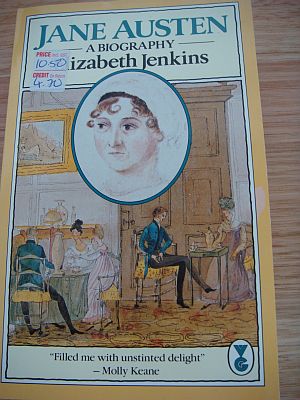
Jane Austen – Elizabeth Jenkins

I found this book (Jane Austen – A biography by Elizabeth Jenkins) at my local second hand book store. What a fabulous find (and it was only $10.50). It’s been out of print for ages.

Oh and I’m slowly making my way through Chapter Five of Jane’s Fame.

Leave a Comment

Filed under Biography, Everything Austen Challenge